
About the Procedure & FAQ
Below are answers to the most common questions, concerns, and procedural details regarding Prosthetic Dentistry (Crowns & Bridges) at Chitra Dental Clinic.
Dentures are classified as:
- Complete dentures: Replace all teeth in a jaw.
- Partial dentures: Replace a few missing teeth. Partials can be classified as (i) Removable and (ii) Fixed. Removable partial dentures replace a few teeth and are designed to be removed and replaced by the patient. Fixed partial dentures (bridges) also replace a few teeth but cannot be removed by the patient.
The extracted tooth should be replaced after the extraction socket has healed about a month later. If delayed, it may result in neighboring teeth migrating or tilting into the extracted area, causing misalignment and chewing difficulties. Learn more about safe tooth extractions and oral surgery.
A fixed denture is better than a removable one because the latter covers more tooth/tissue surfaces, leading to more plaque accumulation and potentially more gingival inflammation. Removable dentures are tissue-supported and can cause the gums to strip from the teeth, resulting in recession, plaque accumulation, bone loss, and damage to adjacent teeth.
Ideally, dentures have to be replaced every 5 years. With the passage of time, there will be a change in the shape and form of the oral tissues that hold the dentures. So in due course, the dentures lose their exact fit and can cause injury and irritation to the underlying tissues. In addition, the acrylic artificial teeth also wear off, meaning they no longer cut and chew food as effectively as before.
Yes, often new dentures cause soreness in the tissues beneath (called Denture Sore Mouth). Even the best-fitting dentures can cause irritation when newly worn, usually due to sharp spots on the denture that irritate the tissue, or sharp bony areas. These should be brought to your doctor’s notice to make the necessary custom adjustments.
Even the best dentures may not perform as well as natural teeth. One has to learn to use the dentures. It is best to avoid hard foods like raw carrots, nuts, etc. Soft foods cut into small pieces are ideal for denture wearers. The food should be chewed on both sides of the mouth simultaneously, in a balanced manner.
Speaking well with new dentures will take some time. Fortunately, most patients learn to speak with their dentures by adapting to them quickly. Speaking problems may persist if the dentures are not made well (e.g., due to improper tooth positioning or excessive thickness). Dentists advise reading aloud from a book or newspaper to help adapt.
Wearing dentures puts strain on tissues beneath; it is essential to give them adequate rest. This is best done by removing them at night while you sleep. When out of the mouth, keep the denture in a bowl of water, as drying out will cause it to warp. Clean them regularly using denture brushes and cleansing solutions. Be careful not to drop them, as they can break.
Broken dentures can be repaired. However, after the repair, the denture must be rechecked in the patient’s mouth by the dentist. Old dentures may also be refitted by relining and rebasing techniques. However, badly worn or severely shattered dentures may require to be remade.
An immediate denture is designed to be inserted immediately after natural teeth are extracted so the patient does not have to go through a period without teeth. They are fabricated using models made prior to extraction, and the healing of tissues goes on below the dentures. They are more complex to make and maintain.
Complete dentures depend on the surface area of the gums for retention. The larger the area, the better the fit. Lower complete dentures are more difficult to retain than upper ones because the tongue is in the way, and after tooth loss, the lower bony ridge starts shrinking over time, leaving less area for the denture to sit on.
A removable partial denture can be made of acrylic (plastic) or a combination of acrylic with a metallic framework (usually cast chrome cobalt or gold based alloy). Metallic cast partial dentures are much superior in strength, thinner, more comfortable, and highly durable.
A dental crown is a custom-made, tooth-shaped cap placed over a damaged or weakened tooth. It encases the entire visible portion of your tooth to restore its size, shape, strength, and appearance.
- Protection: To support a tooth that is cracked, worn down, or weakened by a large cavity.
- Restoration: To cover a tooth following a root canal treatment.
- Support: To hold a dental bridge in place or cover a dental implant.
- Cosmetics: To mask a severely discolored or misshapen tooth.
Crowns are custom-crafted using various materials based on your aesthetic needs, budget, and location:
- Porcelain / Ceramic: Provide the most natural, tooth-colored appearance.
- Zirconia: Known for exceptional durability and natural aesthetics.
- Porcelain-Fused-to-Metal (PFM): Offer strong support combined with a tooth-colored finish.
- Metal (Gold or Alloy): Highly durable and typically used for out-of-sight back teeth.
An FPD (Fixed Partial Denture) is the technical dental term for a dental bridge. It is a permanent, non-removable prosthetic device used to replace one or more missing teeth by “bridging” the gap and anchoring to the natural teeth or implants on either side.
Depending on your dental health, a dentist may recommend one of several designs:
- Traditional FPD: The most common type, where crowns are placed on the healthy teeth on both sides of the gap to hold the pontic in the middle.
- Implant-Supported FPD: Instead of natural teeth, the artificial bridge is anchored permanently to dental implants.
Fixed bridges help restore your ability to chew and speak properly, prevent your remaining teeth from shifting out of place, and maintain your natural face shape. Unlike a conventional Removable Partial Denture (RPD), an FPD is securely cemented in place and does not need to be removed at night.
Clinical Case Studies
Fixed Partial Denture (Bridge) Restoration
Sequence of bridge preparation and placement to replace a missing tooth, restoring a seamless and natural-looking bite.
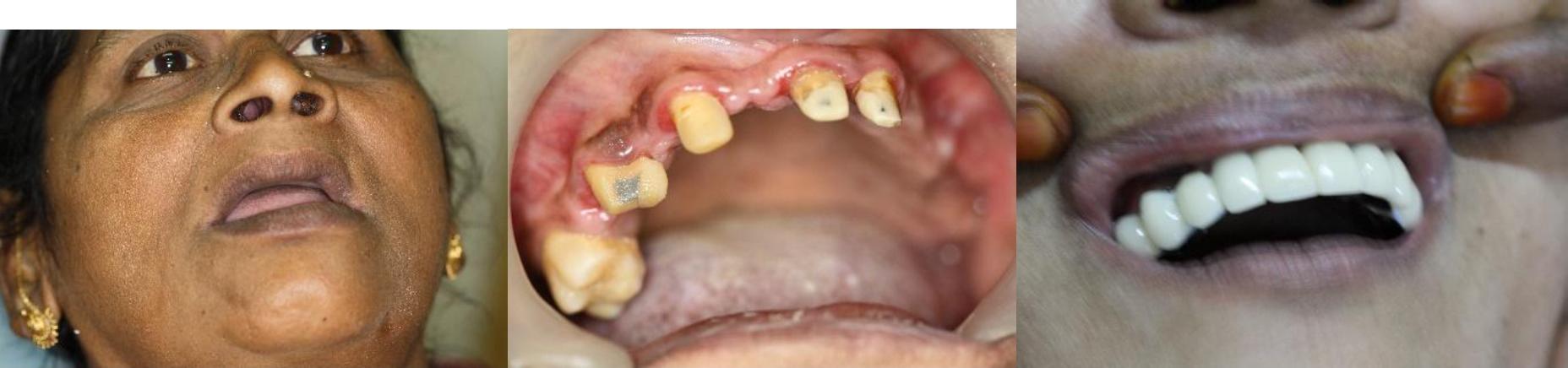 Treatment Steps & Results
Our Treatments
Need Consultation?
Book an appointment with Dr. Chitraa R Chandran and her specialist team today.
Book Appointment044-2371 3282
drchitraa@gmail.com